
Court reporters are responsible for producing accurate, word-for-word records of legal proceedings. Their work forms the official transcript used in courts, tribunals, and public hearings, helping preserve testimony and protect the integrity of the legal process. Understanding how court reporters transcribe speech provides useful insight into both the skill involved and the technology that supports it.
The Role of the Court Reporter
At its core, court reporting involves converting spoken or recorded speech into written form. This is not a simple typing task. Proceedings often move quickly, involve multiple speakers, and include technical legal language. The transcript must reflect everything said with precision, as it may later be relied upon in appeals or other legal matters.
The Stenotype Machine and Its Function
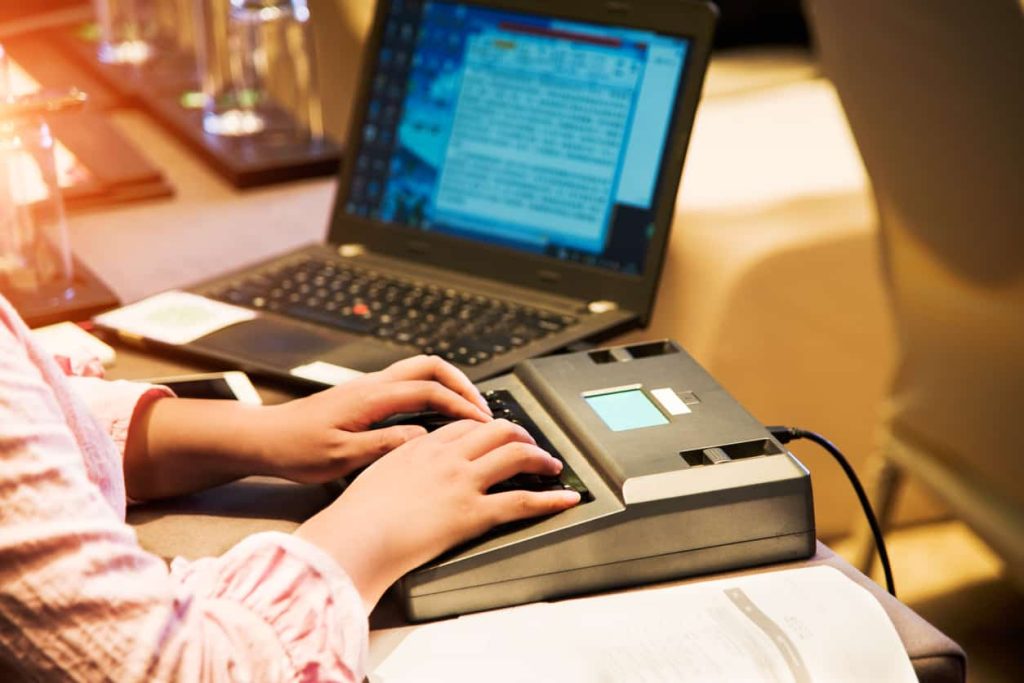
Court reporters rely on a stenotype machine, a specialized typewriter designed for shorthand input. Unlike a standard keyboard, the stenotype has only 22 keys, which are unmarked and arranged in a way that resembles piano keys more than a conventional typing layout. This design allows reporters to press multiple keys at once, producing combinations that represent sounds rather than individual letters.
To perform effectively, court reporters are trained to reach speeds of at least 225 words per minute. This level of performance is possible because the stenotype does not require spelling out each word. Instead, it captures the phonetic structure of speech through coordinated keystrokes.
How Speech Is Captured in Real Time
The transcription process is based on phonetics. The stenotype machine records sounds by dividing words into their components. The reporter’s left hand captures beginning consonant sounds, the thumbs produce vowel sounds, and the right hand records ending consonant sounds. By pressing these keys simultaneously, entire syllables or words can be entered in a single motion.
This system allows court reporters to keep pace with natural speech, even when dialogue is fast or overlapping. The result is a stream of shorthand code that represents everything said during the proceeding.
Translating Stenotype into Readable Text
The output from a stenotype machine is not immediately readable. It appears as a phonetic code that must be translated into standard written language. Modern court reporting relies on software that converts this code into a full transcript.
Rather than relying on individualized shorthand systems, many court reporters now use a standardized translation method. This approach improves consistency and allows software to interpret keystrokes more efficiently. As a result, transcripts can be produced more quickly while maintaining a high level of accuracy.
The Impact of Technology on Court Reporting
Technology has significantly refined how court reporters carry out their work. Stenotype machines can now be connected directly to computers, allowing transcription to appear on screen in real time. This capability is particularly valuable in courtrooms where immediate access to testimony is required or where live captions are needed for individuals who are hearing impaired.
The ability to share transcripts has also improved. Reports can be uploaded and distributed electronically without delay, making them accessible to legal professionals as soon as they are completed. In some cases, systems can support simultaneous translation, which expands accessibility even further.
Remote Transcription and Live Streaming
Recent developments in live streaming have changed where court reporters can work from. Instead of being physically present in a courtroom, reporters can now listen to proceedings remotely and produce transcripts in real time. This approach maintains the accuracy of traditional reporting while offering greater flexibility in how services are delivered.
Court reporters transcribe speech using a combination of specialized equipment, phonetic shorthand, and advanced software. Their ability to capture spoken words at high speed and convert them into accurate written records remains essential to the legal system. While technology has introduced new efficiencies, the role still depends on a high level of training and precision, ensuring that every word spoken in a legal setting is preserved accurately.
To book a court reporter for a meeting or a mediation, or even to discuss a court reporting position with On The Record, call one of our locations today, conveniently located in Whitby and Barrie. We look forward to discussing your court reporting or mediation needs.